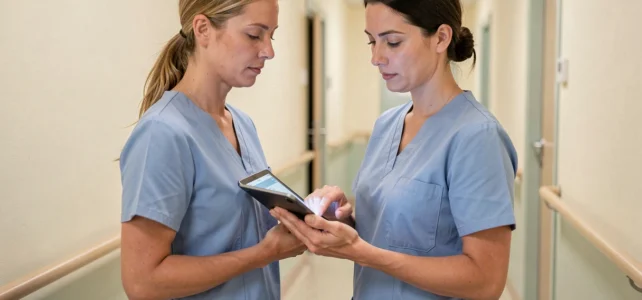
When a nursing assistant finishes their morning rounds and has to return to the care station to enter their observations into the software, they lose valuable time, and details fade away along the way. This is exactly the field problem that the coupling between Netsoins and Netmobilite solves in nursing homes. The former centralizes the computerized user file (DUI), while the latter allows it to be updated in real-time, from the resident’s room or the hallway.
Entry at the bedside: what Netmobilite concretely changes for caregivers
The promise of Netmobilite can be summed up in one sentence: enter observations where they occur, without waiting for the end of the shift. We are talking about a mobile application designed for the constraints of the field, meaning usage on the move, hands often occupied, and lighting that varies between a dark room and a dining area.
The information entered in Netmobilite is immediately written into the Netsoins DUI, without any subsequent re-entry. This is the point that makes the difference from a simple digital notebook. There is no synchronization to trigger manually, no intermediate file to validate. The caregiver notes a change in eating behavior, a mood change, a skin alert, and the coordinating physician sees the information appear in the centralized file.
In practice, the integration of Netsoins and Netmobilite eliminates residual paper transmissions and reduces the infamous end-of-shift double entries, which are the most dreaded by night teams.
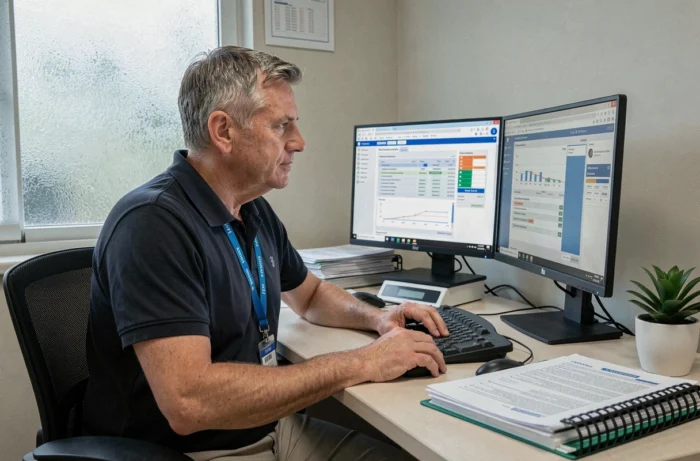
Netsoins as DUI in nursing homes: traceability and Ségur compliance
You do not choose a computerized user file software solely for its interface. Regulatory questions weigh heavily, and they will weigh even more in the coming years.
What the Ségur of digital health imposes
The Ségur program requires nursing homes to equip themselves with a referenced DUI, capable of exchanging health data securely and interoperably. Netsoins meets this framework with hosting compliant with HDS standards (health data host) and GDPR. Every action is traced with a complete history of access, which secures the establishment in case of inspection or dispute.
Wave 2 of the DUI: anticipating new requirements
The “wave 2” DUI raises the level of functional and security requirements for social and medical establishments. Facilities that are already working on a properly configured Netsoins base have a head start. Feedback on this point varies according to the size of the structure, but the logic remains the same: the more the DUI is used daily by the teams, the less compliance feels like a last-minute project.
Teleconsultation integrated into the Netsoins resident file
A teleconsultation module is now directly integrated into Netsoins. In practice, we organize a specialized consultation without moving the resident, and the report is automatically added to the DUI. For a nursing home located far from a hospital center, this changes the game for several specific use cases:
- Remote geriatric advice when the attending physician wants a second opinion on rapid cognitive decline
- Follow-up of chronic wounds by a dermatologist or vascular specialist, with photos integrated into the file
- Renewal of prescriptions by the city doctor, without the resident leaving the facility
The traceability of the report in the DUI avoids information loss between the distant specialist and the on-site care team. There is no longer a need to scan a letter received by fax or to transcribe a phone opinion.
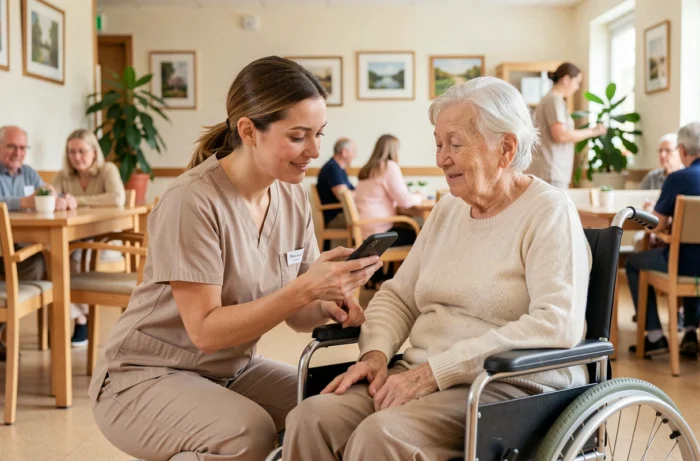
Netsoins configuration in nursing homes: the settings that matter daily
Deploying Netsoins is not just about installing software. The initial configuration determines adoption by the teams. A poorly configured tool will be bypassed in a few weeks, reverting to post-its and transmission notebooks.
The settings not to overlook at startup:
- Configure access rights by profile (nursing assistant, nurse, coordinating physician, management) so that everyone sees relevant information without being overwhelmed
- Adapt data entry grids to the establishment’s protocols, especially for nutritional monitoring and geriatric assessments
- Activate medication alerts and reminders for recurring care, which provide the most concrete safety net against forgetfulness
- Set up targeted transmissions so that the night team receives a usable summary, not a raw data stream
A configuration tailored to the team’s habits reduces training time. Training is more effective when showing a tool that already reflects internal vocabulary and protocols than asking caregivers to adapt to a generic interface.
Training without overloading schedules
Training works better in micro-sessions on the ground than in a full day in a classroom. A few minutes on entering a constant, a reminder on targeted transmissions during the shift change: it is this format of close tutoring that anchors reflexes. Facilities that designate a Netsoins referent by service achieve faster adoption than those that rely solely on initial training.
The coupling between Netsoins and Netmobilite is not a technological gadget. It is an organizational choice that, when well executed, brings back care time where it is most needed: with the resident. The condition is not to treat the deployment as an IT project, but as a change in professional practices, with the accompanying support.