
An eighteen-month-old methodically emptying a kitchen drawer while an adult prepares a meal isn’t misbehaving: they’re exploring shapes, textures and weights. Supporting toddlers’ development day to day starts with recognizing these everyday moments as opportunities to learn.
With screen guidance added to the health record in January 2025 and age-appropriate activities for every stage, parents now have practical ways to support their child’s development from birth to age 3.
Screens and toddlers: what changed in the health record in 2025
Since January 2025, the health record given to parents at birth has explicitly stated: no screens before age 3, even in the background. What was once a general recommendation is now an official guideline that families can see in writing during medical appointments.
What makes this guidance useful in practice is that it also covers passive exposure. A news broadcast playing during dinner or a smartphone left on the coffee table with a video on autoplay interrupts verbal exchanges between adults and babies. Santé publique France notes that this indirect exposure, which is often underestimated, can hinder the interactions toddlers need to develop language skills.
You can visit Petits Bambins news to keep up with recent developments in parenting and early childhood, including recommendations on digital media use in the family.
In practice, the challenge isn’t just taking a screen out of a child’s hands. It also means looking at our own habits as adults. Keeping your phone out of sight during bath time, meals or free play is enough to restore uninterrupted time together. Local authorities are also encouraged to offer cultural and sports activities as alternatives, so that parents aren’t left to shoulder the responsibility alone.
Activities for children aged 0 to 3: match play to your child’s actual age
Offering a six-month-old a shape sorter or giving a two-and-a-half-year-old a rattle means overlooking their current stage of development. The most stimulating activity is one that matches the skill a child is learning—not one they’ve already mastered or one that’s still beyond their reach.
Before walking: the floor as a play space
From birth until those first steps, a play mat is the most versatile place to play. Set out a few objects with different textures (fabric, wood, food-grade silicone) within reach. The goal isn’t to pile up toys, but to let your child handle them, put them in their mouth, drop them and start again.
Mobiles suspended above the mat encourage visual tracking from the first few weeks. At around four or five months, when babies begin reaching for things on purpose, replace the mobile with objects they can grasp and shake.
From first steps to age three: vary movement activities
Once they’re standing, children need to climb, step down, push and pull. Homemade obstacle courses (stacked cushions, a cardboard tunnel, a small step to climb over) meet this need without expensive equipment. Outdoors, a grassy slope or low wall offers a manageable physical challenge.
- Pouring water or sand between two containers develops hand-eye coordination and an understanding of volume, from around eighteen months.
- Play dough or salt dough engages fine motor skills (squeezing, shaping and cutting) and introduces children to creating three-dimensional forms at around age two.
- Simple pretend-play games (feeding a doll, pretending a banana is a phone) emerge naturally around age two and strengthen language and social understanding.
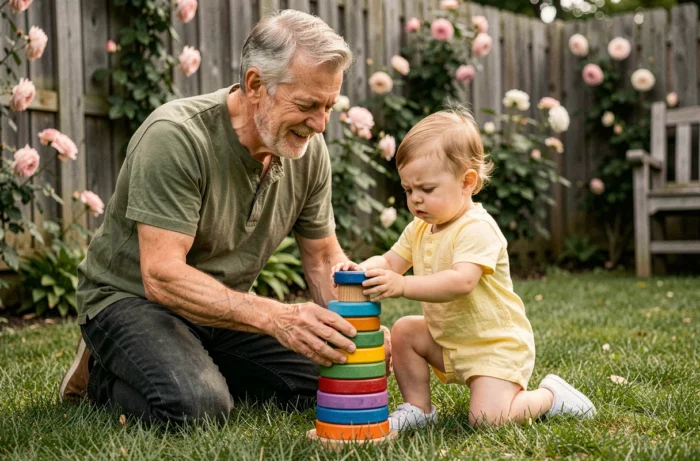
A common mistake is to direct the activity from start to finish. Letting a child use an object in an unexpected way (stacking cups instead of drinking from them) is part of the learning process. Step in for safety, not to control the outcome.
Everyday developmental milestones: observe without comparing
Age-based developmental charts (first words, first steps, potty training) are guideposts, not deadlines. A child who walks at ten months and another who walks at sixteen months are both within the typical range. The pace varies considerably depending on each child’s build, temperament and environment.
What warrants close attention are changes in a child’s developmental trajectory: a child who used to babble and stops, or a toddler who avoided eye contact, began making it and then stops again. These signs are worth discussing with your family doctor or pediatrician at a routine appointment listed in the health record.
In everyday life, you can keep three simple things in mind:
- Does your child seek an adult’s gaze or attention during free play?
- Do they use gestures to communicate (pointing, handing over an object) even before their first words?
- Are they gradually able to manage brief separations (a few minutes in another room, for example) without prolonged distress?
These three points cover communication, social connection and emotional security. If progress in any one of these areas stalls for a long time, raising it at an appointment can help you act early without causing unnecessary alarm.
Daily routines and rituals: structure the day without making it rigid
Toddlers don’t need a minute-by-minute schedule, but they feel more settled when the main parts of the day happen in a predictable order. Meals, naps, free play and time outdoors provide enough structure for most children between the ages of one and three.
A common pitfall is trying to fill every slot with a planned activity. In between the main parts of the day, quiet moments (looking out the window, handling a piece of string, babbling alone) aren’t wasted time. They give the brain a chance to consolidate recent learning.
When it comes to naps, observation is the best guide: a child who rubs their eyes, yawns or becomes restless for no apparent reason is showing signs of tiredness. Insisting on a fixed schedule when those signs aren’t there can have the opposite effect. Adjust the nap’s timing and length based on what your child shows you, not what the schedule says.
A toddler’s development is shaped by these everyday details: a drawer to explore, a slope to climb, an attentive adult who puts down their phone. There’s no need for an elaborate program. The simplest actions, repeated consistently and with care, remain the most effective way to support children in their early years.