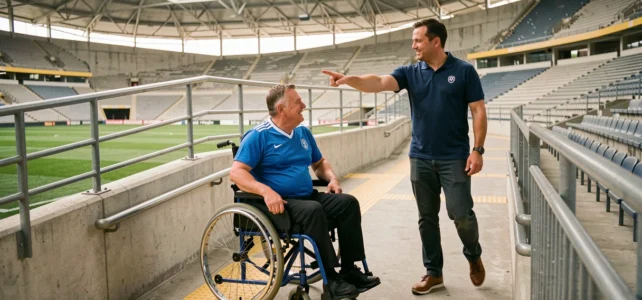
Booking a wheelchair-accessible seat in a stadium is not just about ticking a box on a ticketing form. Between the ERP classification of the venue, the type of declared disability, the required documentation, and the validation deadlines, the purchasing process involves technical steps that most general guides overlook.
Accessibility QR codes and public register: tools to check before booking
An increasing number of stadiums are deploying dynamic accessibility QR codes that direct to routes without steps, elevators, accessible restrooms, sensory rooms, and hearing assistance devices. We recommend scanning these QR codes from the stadium’s accessibility page even before purchasing a ticket: they help assess the actual compatibility of the venue with a wide electric wheelchair or a walker.
Another point that few spectators check is the public accessibility register. All ERP venues, including stadiums, must make this document available to the public, either in physical form or on a dedicated web page. It describes the accessible pathways, seating areas, adapted restrooms, available equipment, and known limitations along with their alternative solutions. If the register is not published online, a simple email request to the venue manager is enough to obtain it.
This register is the only enforceable document that precisely details what the stadium offers. It prevents unpleasant surprises on match day, especially in older venues where compliance remains partial.
Wheelchair ticketing process: procedures by venue type
The booking procedures vary greatly depending on the manager. At the Stade de France, the order goes through a dedicated “PSH Reservation” page accessible on the day of the general sale. The spectator selects their type of disability, simultaneously reserves their seat and that of the companion, and then has a seven-day deadline to send their documentation (Disability or Priority Mobility Inclusion Card) to the specified email address. Without sending within this timeframe, the order is canceled.
For Ligue 1 or Ligue 2 clubs, the procedure depends on each ticket office. Some clubs integrate a PMR pathway directly into their online system, while others require a phone call or a specific form. The concrete challenge, when wanting to visit a stadium with disabled access, is to identify the right channel before the sale opens to avoid facing an exhausted quota.
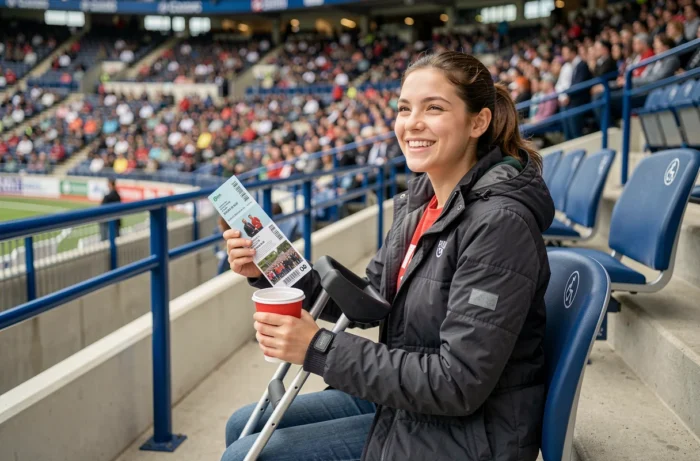
The accepted documentation is almost always the same:
- Mobility Inclusion Card marked “disability” or “priority,” clearly readable on both sides
- Valid MDPH certificate if the CMI has not yet been issued
- European parking card for requests related to the stadium’s PMR parking
We observe that some stadiums now refuse reservations by phone or email for concerts, accepting only the online pathway. Checking this information in the stadium’s ticketing FAQ avoids considerable time loss.
Companion seats and pricing categories: what changes depending on the stadiums
The companion seat is systematically offered, but its price varies from one stadium to another. Some venues offer free admission for the companion of the CMI holder, others apply a reduced rate, while others charge the full price. This information rarely appears on the main ticketing page: it is found in the general sales conditions or in the public accessibility register.
PMR seating is generally located at the top of the lower stands. There is a choice of category, but it is limited by the physical configuration of the venue. In newer stadiums, several areas spread over different levels are accessible. In older venues, a single area concentrates all the seats, which reduces visibility options.
Priority entry and assistance on match day
At the Stade de France, a priority entrance is located to the left of the door indicated on the ticket. Agents identified by a white vest assist PMR spectators to their seats. This system is not widespread: in medium-sized venues, assistance often consists of ground signage only.
Arriving at least an hour before kickoff remains the most reliable recommendation to avoid queues at security checks, which do not always have a dedicated PMR lane.
Closure of the Territorial Accessibility Fund: consequences for small stadiums
The Territorial Accessibility Fund, created by decree n° 2023-993 and opened on November 2, 2023, aimed to finance the accessibility of small ERP venues (category 5). This fund was closed in 2026, depriving managers of small venues of national assistance to adapt their facilities.
In practical terms, this means that some stadiums of amateur clubs or lower divisions may see their compliance slow down. For wheelchair users, the direct consequence is very heterogeneous accessibility depending on the venues:
- Ligue 1 stadiums and large venues generally meet current standards
- Category 5 stadiums may present incomplete pathways, non-adapted restrooms, or a lack of dedicated PMR seats
- Venues undergoing renovation sometimes publish an Ad’AP (Scheduled Accessibility Agenda) available at the town hall, detailing the planned works and their deadlines
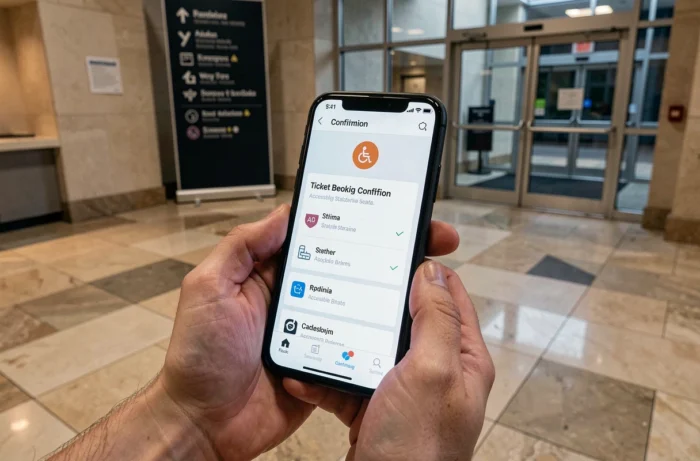
Before booking in a small stadium, consulting the accessibility register or contacting the manager by email remains the only way to confirm that the location meets one’s actual needs. A stadium that is compliant on paper may present practical obstacles (excessive slope, insufficient passage width for an electric wheelchair) that only the detailed register can help anticipate.