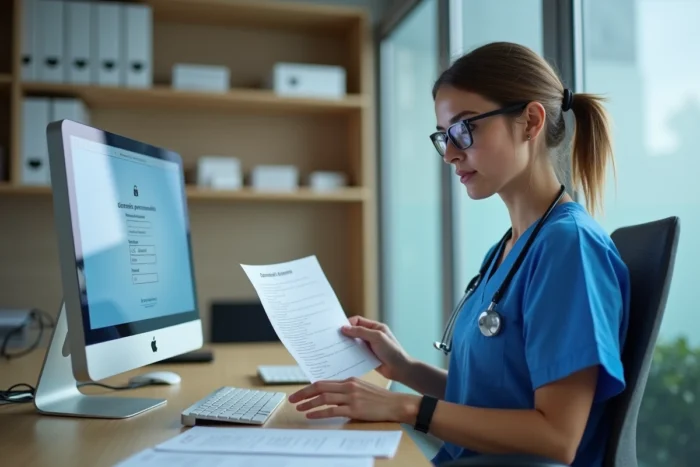
A caregiver consulting a resident’s medical file on a shared tablet, a generic password stuck on the screen of the nursing station, an IT subcontractor accessing prescriptions without a processing contract: these situations exist in many nursing homes. They expose residents to health data leaks and the facility to sanctions from the CNIL.
Data security in nursing homes is not limited to a well-filled processing register. It plays out in the daily actions of staff, the configuration of digital tools, and the rigor of access.
Access Management to Resident Files in Nursing Homes
On the ground, the primary risk does not come from a hacker. It comes from a user account shared among three caregivers, or from an administrator profile assigned by default to the entire team. Each professional must have a named access with rights limited to what they need to perform their function.
A caregiver does not need to consult family correspondence stored in the management software. A secretary does not need to open geriatric consultation reports. Rights are segmented by profession, and these rights are reviewed with each job change or departure.
Facilities that use care software like Netsoins can access Netsoins Domusvi to consult best practices for profile configuration and connection traceability.
Traceability, indeed, remains a frequent blind spot. Activating connection logs allows knowing who accessed which file and when. Without these logs, it is impossible to detect abnormal access or respond to a request for the exercise of rights from a resident or their family.
Legal Basis for Health Data Processing in Nursing Homes
GDPR compliance for a nursing home is not limited to displaying a privacy policy in the reception area. The CNIL expects each processing of personal data to be linked to a specific legal basis, verified on a case-by-case basis.
In practice, several categories of processing coexist within the same facility:
- Medical follow-up and care coordination are based on legal obligation and the safeguarding of vital interests (Article 9 of the GDPR), not on the resident’s consent.
- Administrative management (billing, accommodation, social assistance) relies on the execution of the accommodation contract or a legal obligation.
- Video surveillance of common areas requires documented legitimate interest, with a proportionality analysis.
- Photos of the resident used in an internal newsletter or on a website require free and informed consent, obtained from the resident or their legal representative.
Confusing these legal bases exposes one to a double risk: requesting consent where it is not required (which leads the resident to believe they can oppose care), or failing to request it where it is mandatory. Each processing is documented in the register with its purpose, legal basis, retention period, and recipients.
Ransomware and Business Continuity in Social Medical Facilities
The ransomware threat remains structurally high for health and social medical facilities. Nursing homes are targets because they combine sometimes outdated information systems, reduced IT teams, and health data with high black market value.
When ransomware encrypts the server hosting care files, the continuity of care collapses. No access to prescriptions, documented allergies, or individual protocols. We revert to paper, with all the risks of error that entails.
Concrete Cyber Prevention Measures in Nursing Homes
Prevention does not require a colossal budget. It relies on operational practices that management and the IT referent can gradually implement:
- Regularly tested offline backups: a backup that has never been restored guarantees nothing.
- Updates of operating systems and business software as soon as security patches are published.
- Raising staff awareness of phishing emails, with short and repeated reminders rather than an annual training forgotten the next day.
- Network segmentation: the reception desk should not be on the same segment as the medical records server.
Feedback varies on the ideal frequency of restoration tests, but a quarterly test is a reasonable minimum for a medium-sized facility.
Role of the DPO and Training of Care Staff on GDPR
The appointment of a Data Protection Officer (DPO) is mandatory for nursing homes. This DPO cannot be the facility’s director or a member of management, to avoid conflicts of interest. The DPO can be a trained employee or an external provider specialized in the social medical sector.
His role goes beyond document writing. He monitors compliance with practices on a daily basis, supports teams in concrete situations (a resident’s son requesting the entire medical file, a request for data deletion, a security incident), and ensures the link with the CNIL in case of inspection.
Training Without Overwhelming the Care Team
Care staff will not remember a two-hour e-learning module on GDPR principles. What works are short sessions focused on daily actions: locking their session when leaving the workstation, not transmitting health data via unsecured messaging, immediately reporting any suspicion of unauthorized access.
These reminders are integrated into existing team meetings rather than creating an additional event. A concise display near computer workstations complements the system without adding to the workload.

The protection of residents’ personal data in nursing homes relies as much on technical configuration as on the team’s culture. An up-to-date processing register, named accesses, tested backups, and an engaged DPO in the actual functioning of the facility form a solid foundation. The last link remains the reflex of each professional who handles this data daily.