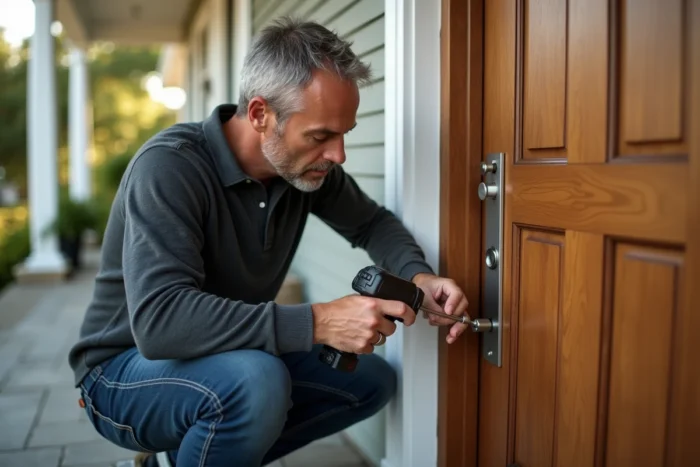
Which home security devices offer a truly favorable protection/cost ratio, and which are more about marketing? Between smart locks, surveillance cameras, wired or wireless alarms, and new smart sensors, the global smart home security market is expected to reach 33.2 billion USD by 2025 according to Fortune Business Insights. This growth reflects massive adoption, but it says nothing about the actual effectiveness of each solution at the level of an individual home.
Cybersecurity of connected objects: the weak link in home protection
Competing articles extensively detail locks, shutters, and outdoor lighting. None address the risk posed by an unsecured connected device. A surveillance camera connected to your home Wi-Fi without adequate protection becomes a digital entry point, sometimes easier to breach than a window.
Europe is now pushing for strict regulation. A European cybersecurity label (Cybersecurity Label) is starting to distinguish reliable equipment. For a device to earn your trust, several technical criteria must be met:
- A guarantee of software updates for at least 5 years, contracted by the manufacturer, to fix vulnerabilities discovered after purchase.
- Segmentation of the Wi-Fi network: the family network (computers, phones) must be separated from the network dedicated to connected objects (cameras, locks, sensors).
- The systematic activation of two-factor authentication for any remote control, whether unlocking a lock or viewing a video stream.
Without these precautions, a connected alarm system can paradoxically weaken your home’s security. The most organized burglars are already exploiting the vulnerabilities of non-segmented home networks.
The security solutions offered on the Protect Habitation website for homes allow for evaluating devices according to these criteria before any investment.
Wired alarm, wireless alarm, and remote monitoring: comparative table of systems
The choice of an alarm system depends on the type of housing, budget, and desired level of protection. Rather than listing generic advantages, here is a factual comparison of the three main families of devices.
| Criterion | Wired Alarm | Wireless Alarm | Remote Monitoring |
|---|---|---|---|
| Installation | Necessary work (wiring in the walls) | Simple installation, no major drilling | Installation by a certified technician |
| Signal Reliability | Very high (no radio jamming possible) | Vulnerable to jamming if no anti-jamming detection | Dual channel (Wi-Fi + GSM) on most offers |
| Remote Control | Limited unless a connected module is added | Standard smartphone app | App + 24/7 monitoring center |
| Installation Cost | High (labor + equipment) | Moderate | Variable (often equipment included in the subscription) |
| Recurring Cost | None | None (except for battery replacements) | Monthly subscription |
| Suitable for | New construction, large house | Apartment, renovation, rental | Main residence with frequent absences |
The wired alarm remains the benchmark in pure reliability. However, its installation cost makes it less relevant for a rental apartment or an old house where running cables would be destructive.
The wireless alarm is suitable for most homes, provided that an anti-jamming feature is present. Without this protection, a simple radio jammer, available for a few dozen euros, can neutralize the entire system.
Outdoor and indoor surveillance cameras: technical selection criteria
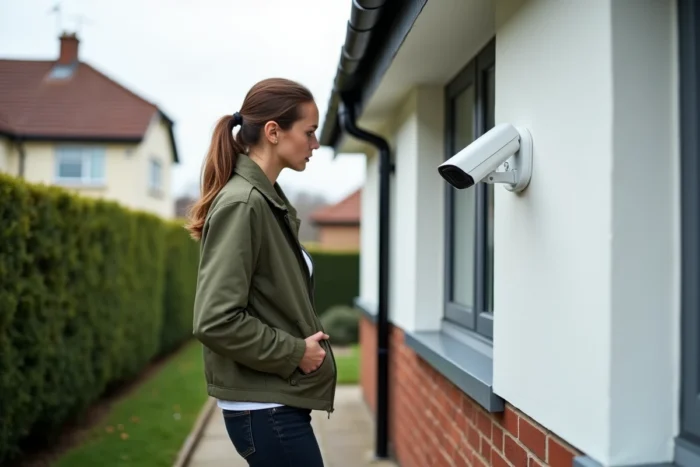
The placement of a camera is as important as its resolution. An outdoor camera aimed at the public road poses a legal problem: the law requires that the field of vision be limited to your property. Filming the sidewalk or the neighbor’s facade exposes you to penalties.
For the outside, three technical characteristics deserve particular attention. Infrared night vision, first, because the majority of intrusion attempts occur in the absence of occupants, often at night or during the day while at work. An IP65 or higher protection rating, next, to withstand the elements. Motion detection with filtering (people vs. animals), finally, to avoid false alerts.
For the inside, a camera with a physical lens shutter protects privacy when you are home. Purely software models (deactivation via app) remain vulnerable to hacking of the video stream.

Local or cloud storage: a trade-off between security and practicality
Cloud storage allows you to keep images even if a burglar takes the camera. Local storage (SD card, NAS) keeps your data off third-party servers.
Hybrid storage (local + encrypted cloud) offers the best compromise: images remain accessible remotely, but a local copy remains in case of internet outage. Ensure that end-to-end encryption is active, not just encryption in transit.
Physical reinforcement of access points: doors, windows, and neglected entry points
Police statistics regularly remind us that the front door and ground floor windows account for the vast majority of break-ins. Two physical investments produce a measurable deterrent effect.
The first concerns the lock. A multi-point lock (three or five locking points) certified A2P significantly slows down an attempt at picking or drilling. The A2P certification classifies locks into three levels of resistance: one star (5 minutes of resistance to break-in tested in a lab), two stars (10 minutes), three stars (15 minutes).
The second concerns windows. A burglary-resistant glazing (rated P2A minimum according to standard EN 356) does not make the glass unbreakable, but it requires several impacts before giving way, which extends the intrusion time and increases the noise produced. Automatic locking aluminum roller shutters add an extra layer, especially on ground floor bay windows.
A often neglected point: the garage door. On older tilting models, a simple crowbar is enough to force access. A lateral locking system or an opening detector connected to the alarm addresses this vulnerability without a complete door replacement.
The residential security market is expected to reach 38.11 billion USD by 2026 according to projections from Fortune Business Insights, indicating that the combination of physical and digital solutions is becoming the norm. The key remains to assemble these devices according to the actual vulnerabilities of your home, not to stack equipment without overall coherence.