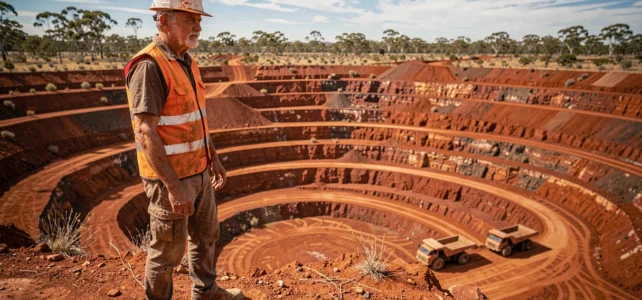
The Australian mining sector employs several hundred thousand people spread across sites often located several hours by flight from major coastal metropolitan areas. Behind the salary figures circulating on social media, the daily lives of these workers are subject to physical, logistical, and psychological constraints that are rarely detailed. Long rotations, isolated camps, extreme heat: the functioning of this industry relies on a distinct lifestyle structured around the FIFO (Fly-In, Fly-Off) system.
FIFO Rotation and Time Organization in Australian Mines
The vast majority of mining sites in Western Australia, Queensland, or the Northern Territory operate on a rotation model. Workers spend a continuous period on site, usually two weeks, followed by an equivalent period of rest at home. Some rotations extend to three weeks of work for one week of rest, depending on the position and employer.
On site, days start before dawn. Twelve-hour shifts, both day and night, are the norm. The remaining time is divided between meals at the mess (the camp cafeteria), a short leisure window, and sleep. The organization is almost military: fixed schedules, collective transport to extraction areas, daily safety briefings.
For those interested in working in Australian mines, this binary rhythm of total presence on site and total absence from home defines the entirety of social and family life. Field returns vary on this point: some workers appreciate the long periods of continuous rest, while others describe an increasing difficulty in maintaining stable relationships.
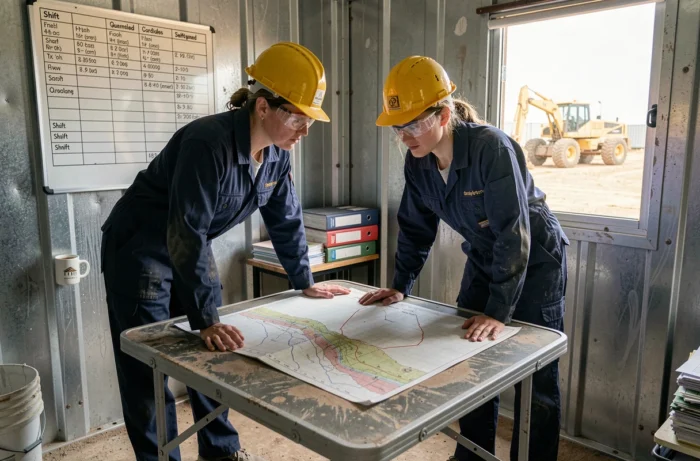
Living Conditions in Mining Camps: Accommodation, Meals, and Isolation
Mining camps, sometimes referred to as villages, host anywhere from a few hundred to several thousand temporary residents. Each worker has an individual room, often a converted container or a prefabricated module (donga), equipped with a bed, a bathroom, and air conditioning. Comfort varies by operator: camps managed by large groups have invested in modern infrastructure, while others remain spartan.
Meals are provided and covered by the employer. Cafeterias typically offer three meals a day, tailored to the staggered schedules of teams. Food in camp covers all needs at no cost to the worker, which significantly contributes to the often-highlighted ability to save.
Isolation remains the most commented factor by the workers themselves. Outside of shift hours, options are limited to a gym, a communal television room, and, at some sites, an outdoor sports field. Mobile network coverage is uneven across areas, and video calls with family depend on the quality of the wifi provided by the camp.
What Camps Cannot Replace
Leisure, varied social interactions, the ability to walk freely: all of this disappears during the rotation. Several workers interviewed in published testimonials mention a feeling of “bubble” where days look alike. The monotony of the living environment amplifies the fatigue accumulated from long shifts.
Mental Health of FIFO Workers: An Issue Recognized by the Sector
The psychosocial risks associated with mining work in Australia are now subject to specific sectoral regulation. In 2025, the International Council on Mining and Metals (ICMM) published its tools dedicated to psychological health and workplace safety, aligned with the ISO 45003:2021 standard. This framework provides the mining sector for the first time with a structured approach to managing psychosocial risks.
Research from the Sustainable Minerals Institute at the University of Queensland identifies three key factors for the mental health of FIFO workers:
- The structure of rotation schedules (length of the swing, regularity, predictability of roster changes)
- The quality of the relationship with direct supervisors, which strongly influences the sense of support on site
- The material conditions of the camp, particularly access to decent rest areas and quality food
These factors weigh more heavily on well-being than salary level, according to this research. The high turnover at some sites is explained less by physical hardship than by the accumulation of frustrations related to daily organization.
Safety and Harassment on Mining Sites: Persistent Gray Areas
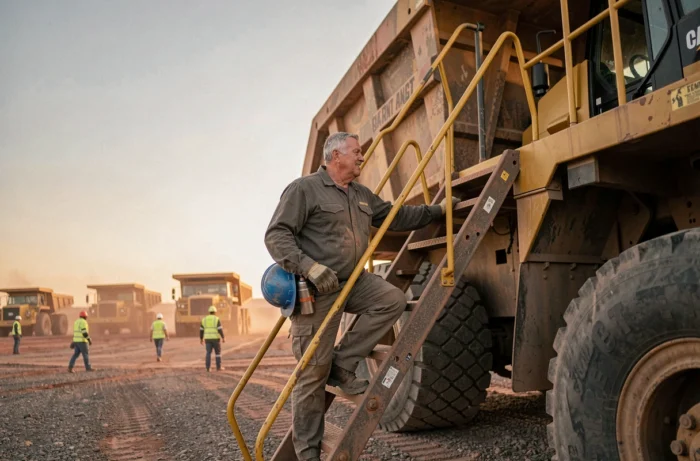
The Australian mining sector applies strict physical safety protocols. Briefings before each shift, the wearing of personal protective equipment, and regular audits are part of daily life. The rates of serious accidents have decreased over the last decade due to the partial automation of certain tasks and enhanced monitoring.
However, the issue of sexual harassment on sites remains an open topic. In 2026, a report revealed that 113 cases of sexual harassment had been documented at BHP, one of the largest mining operators in the country. The same year, Fortescue commissioned an external law firm to investigate similar allegations. These cases show that the culture at some sites, despite stated policies, has not yet integrated the expected transformations.
The available data does not allow for conclusions about the actual extent of the phenomenon across the sector. The publicly reported cases concern large groups, subject to transparency obligations. Smaller sites or subcontractors remain less documented.
Automation and Job Evolution in the Australian Mining Sector
The increasing introduction of autonomous technologies is transforming the nature of available positions. Driverless transport trucks are already operating at several sites in the Pilbara. Remote control centers, located in Perth, allow operators to pilot equipment located more than a thousand kilometers away.
Unskilled manual positions are gradually decreasing, replaced by technological supervision roles. For workers on Working Holiday Visas or temporary visas, accessible jobs are concentrated in ancillary services: cleaning, catering, light maintenance. Technical positions require specific certifications and industry experience.
This shift is also changing the profile of the camps. Fewer workers on site, more monitors in town: the mining daily life of tomorrow will resemble less and less that described by current testimonials. The FIFO model itself could evolve if the share of work that can be done remotely continues to grow.
The Australian mining sector remains a unique universe, where favorable material conditions coexist with profound isolation and documented psychosocial risks. The reforms initiated since 2025 on mental health and transparency around harassment show a sector in transition, but whose daily practices evolve more slowly than official policies.