
A child crying for an hour without an identifiable reason, a meal ending up on the floor, another sleepless night. These situations are part of the daily life of most households. However, discussing parental difficulties without a filter remains a rare exercise, hindered by the fear of judgment and the image of the parent who manages everything without faltering.
When parental silence becomes a health risk factor
The Évane study, conducted by Public Health France and the CNAF among more than 10,000 parents of children under two years old, describes chronic fatigue, social isolation, and massive educational doubts. The authors speak of an “emotional vulnerability landscape” that affects a large majority of households.
This finding changes the game. Parental exhaustion is now treated as a public health issue, not just a temporary slump. Public Health France dedicates a separate file to it apart from depression and estimates that it affects about 6% of people in France, mainly women.
The problem is the gap between this documented reality and what parents dare to express around them. The pressure of being the perfect parent exacerbates distress and delays the request for help. A silent parent is not a parent who is doing well; they are often a parent who is sinking.
Some online spaces are beginning to lift this lock. For example, you can discover the Club des Parents website, which gives a voice to mothers and fathers about their real struggles, without injunctions or moral lessons.
Parental stress and child behavior: a cycle that words can break

Have you ever noticed that a child becomes more agitated when the atmosphere at home is tense? It’s not a coincidence. A parent’s chronic stress alters their reactions to the child’s behavior. Anger rises more quickly, patience wears thin, and responses become mechanical.
An exhausted parent more often interprets normal behavior as a problem. A three-year-old refusing to get dressed is not being oppositional; they are experimenting with their autonomy. The difference between these two interpretations largely depends on the parent’s emotional state at that moment.
Naming this fatigue out loud, in front of a loved one, a professional, or even in a support group, produces a concrete effect. The parent gains perspective on the situation. They distinguish what pertains to the child and what pertains to their own exhaustion. This mental sorting is the first step to breaking the cycle.
What research shows about the parent-child relationship under pressure
Research published in Frontiers in Psychology in 2026 confirms that parental burnout measurably alters the quality of the parent-child relationship. Parents experiencing exhaustion report more conflicts, fewer moments of shared play, and increasing emotional distance.
The takeaway: it is not a lack of love that creates this distance. It is a lack of resources, sleep, and support. Saying “I can’t handle it tonight” protects the relationship much more than gritting one’s teeth in silence.
Parental guilt: why mothers bear a specific burden
Data from Public Health France confirms it: women are predominantly affected by parental exhaustion. This asymmetry is not solely explained by domestic mental load. It also stems from the social pressure surrounding the maternal role.
A mother who says “I am at my wit’s end” exposes herself to a judgment that fathers rarely face. The external gaze transforms a legitimate confession into an admission of incompetence. This mechanism drives many women to maintain a facade, even in front of their partner.
Talking openly about parental difficulties also involves a change in collective vocabulary. Here are some concrete guidelines for adjusting the perspective:
- Replace “can’t you manage?” with “what would help you concretely?” when a parent expresses their fatigue
- Stop comparing families to each other; each child, each family configuration generates different constraints
- Accept that a parent can deeply love their child and go through moments when everything weighs heavily on them; the two do not exclude each other
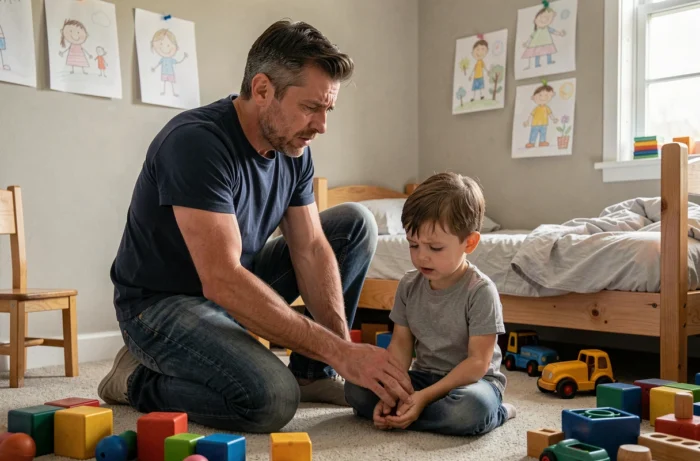
Finding the right people to talk about parenting difficulties
Talking, yes, but to whom? The choice of interlocutor changes everything. Confiding your fatigue to someone who responds “enjoy it, it goes by quickly” reinforces isolation instead of reducing it.
Support systems for parenting have expanded in recent years. Here are the most accessible formats:
- Support groups led by professionals (PMI, social centers, local associations), where confidentiality is guaranteed and judgment is absent
- Listening lines dedicated to parents, allowing them to verbalize a crisis situation without an appointment
- Specialized blogs and forums, which provide a first space for expression for parents who are not yet comfortable speaking face-to-face
- Consultations with a psychologist trained in parental burnout, providing individual support tailored to the heaviest situations
Asking for help is not a sign of parental weakness; it is a skill. A parent who identifies their limits and seeks support protects their family just as much as one who prepares three balanced meals a day.
The role of the partner and close circle
The first support often remains the co-parent, when one exists. Establishing a regular moment to share what weighs on you, without seeking an immediate solution, is sometimes enough to defuse the buildup. Five minutes in the evening, after the children are in bed, without screens.
For single-parent families or those lacking family support, networks of mutual aid among parents (shared care, service exchanges) provide a concrete alternative to isolation.
Talking about parental difficulties does not solve everything. Nights remain short, and the tantrums of a two-year-old do not disappear magically. What changes is the parent’s ability to navigate these moments without collapsing alone. Speaking does not eliminate the burden; it prevents the burden from becoming a wall.