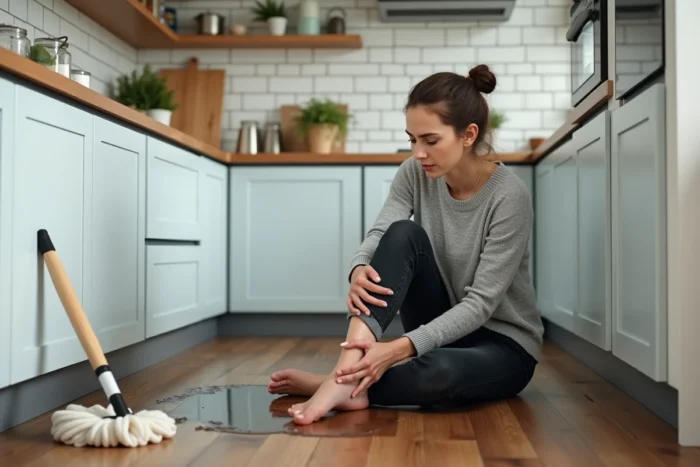
Every year in France, accidents in daily life account for a major cause of hospitalization and death, far ahead of road accidents. Most occur at home: falls, burns, poisoning, cuts while doing DIY.
In the face of these risks, Social Security and health insurance reimburse medical care, but not the financial consequences of a disability or prolonged immobilization. The question then arises: what does domestic accident insurance actually cover, and what areas of compensation do other contracts overlook?
Home insurance, GAV, and provident insurance: what each contract covers (and what it excludes)
The most common confusion concerns the scope of home insurance. This contract protects your property and your civil liability towards third parties, but it does not compensate you if you are yourself a victim of an accident at home without a responsible third party.
| Type of contract | Coverage in case of domestic accident without third party | Compensation for bodily injury | Home assistance |
|---|---|---|---|
| Home insurance | No (property and liability only) | No | Rarely |
| Life Accident Guarantee (GAV) | Yes, from a disability threshold | Yes (disability, death, enjoyment damages) | Yes, depending on the contract |
| Individual provident insurance | Variable depending on options | Partial (lump sum or annuity) | Variable |
| Health mutual | Care and hospitalization | No (no financial compensation for disability) | No |
The table highlights a blind spot: without GAV, no compensation for disability after a domestic accident without a responsible third party. Home insurance, contrary to what many believe, does not intervene in this scenario.
This is precisely the gap that domestic accident insurance fills, covering the financial consequences of an accident that occurs in your private life, whether at home, on vacation, or during leisure activities.

Disability threshold and GAV compensation: the determining criterion of the contract
Not all GAV contracts are equal. The criterion that makes the difference is the partial permanent disability (IPP) threshold at which compensation is triggered. Some insurers offer triggering from 5% or 10%, while others set a much higher threshold.
The difference is considerable. A poorly healed wrist fracture, an extensive burn, or a severe knee sprain can leave sequelae assessed between 5% and 25% of IPP. With a high threshold, these situations do not entitle you to any compensation.
What a low IPP threshold covers
- Partial loss of mobility after a fall down the stairs, even without prolonged hospitalization, if it results in at least 5% permanent disability
- Functional sequelae from a DIY accident (severed finger, tendon injury) that limit the ability to perform certain activities
- Documented psychological consequences of a serious domestic accident, taken into account in the assessment of enjoyment damages
When choosing a contract, comparing the IPP threshold before the amount of the compensation cap gives a more realistic view of effective protection. A high cap with a high threshold mainly protects against the most serious accidents, which remain statistically rare.
Assistance services after a domestic accident: beyond financial compensation
Recent contracts no longer limit themselves to paying a lump sum or annuity. Several insurers now include concrete assistance services to maintain daily life after an accident.
These services often kick in as soon as hospitalization occurs, sometimes even in cases of home immobilization without hospitalization. Crédit Agricole, for example, mentions home assistance including housekeeper services, childcare, meal delivery, and garden maintenance in the event of hospitalization. MAE provides housekeeper assistance, the relocation of a loved one, medication delivery in case of immobilization, as well as emergency domestic assistance (power outage, water leak, lost keys).
These services change the very nature of the contract. Life accident insurance becomes a logistical safety net, not just a financial one. For a household with children or a person living alone, immediate support for daily life during recovery reduces stress and accelerates the return to normalcy.

Geographic scope and activities covered by the GAV
The GAV is not limited to the home. Most contracts cover accidents that occur throughout private life: amateur sports, gardening, vacations abroad, pedestrian travel. However, road accidents and work accidents fall under specific regimes and are excluded.
Activities and places generally covered
An accident during a dance class, an injury while hiking, a fall in a public staircase, food poisoning at home: all these scenarios fall within the scope of a standard GAV. Some contracts add worldwide coverage for stays abroad, with repatriation and on-site support.
Children and the elderly are the most exposed profiles to accidents in daily life. Family contracts cover the entire household, including minor children, without additional premiums per person in most offers.
The cost of a GAV remains moderate compared to the amounts of possible compensation. The real trigger for subscribing is often the realization that no other existing contract covers bodily injury suffered without a responsible third party. Checking current contracts allows you to identify this gap before an accident reveals it.