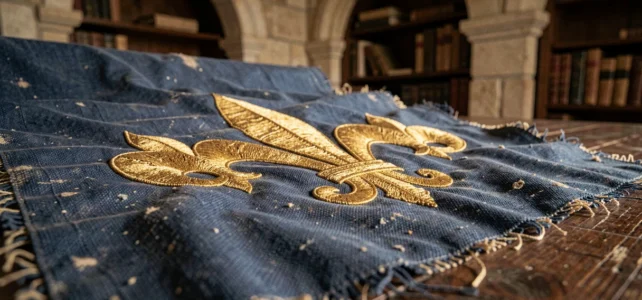
The fleur-de-lis has been associated with the French monarchy for centuries, but the historical reality of its use on royal flags and standards is more nuanced than common representations suggest. Distinguishing the arms of the kingdom from the king’s standard, identifying the period when the motif truly became fixed, and understanding why this symbol persists in the French public space long after the end of the monarchy deserve careful examination.
White standard and azure arms: two often confused objects
Most articles illustrate the subject with a blue background scattered with golden fleurs-de-lis. This image corresponds to the arms of France, not to the royal standard in the strict sense. The standard of the kings of France had a white background, a color that represented the command of the sovereign in person. The blue scattered with lilies pertains to heraldry, that is to say, the coat of arms, used on seals, shields, and official documents.
This confusion is explained by the absence, under the Ancien Régime, of a national flag in the modern sense. Before the French Revolution, no unique emblem fulfilled all the functions that the tricolor assumes today. Public buildings did not display a flag, but the arms of the relevant authority. The white background was used on battlefields, while the blue with lilies appeared on objects related to royal dignity.
To delve deeper into this distinction between heraldic emblem and military standard, the flag of the kings of France with fleur-de-lis is the subject of a detailed analysis that sheds light on the different functions of these symbols.

Fleur-de-lis on the royal coat of arms: a gradual fixation over the centuries
The association between the fleur-de-lis and the crown of France did not happen overnight. The motif appears diffusely in royal iconography from the 12th century. Louis VII seems to be the first sovereign to use it regularly on his seals and banners. Philip Augustus continues this anchoring by integrating the lily into the Capetian coat of arms.
From the scattering of lilies to the three flowers of Charles V
For more than two centuries, the royal coat of arms features a scattering of lilies, that is, an indeterminate number of flowers spread across the entire azure field. This motif is sometimes referred to as “ancient France.” It is Charles V who fixed the number of flowers to three in 1376, creating what heraldists call “modern France.”
The choice of the number three is not insignificant. The most widespread interpretations see it as a reference to the Christian Trinity (Father, Son, Holy Spirit), which reinforces the theological dimension of the Capetian monarchy. The king of France presented himself as God’s lieutenant on earth, and the lily served as a visual proof of this mission.
- Before 1376, the coat of arms was a scattering of lilies without a fixed number, called “ancient France”
- The ordinance of Charles V reduces the motif to three golden fleurs-de-lis on an azure background
- This “modern France” version remains stable until the end of the monarchy, crossing the Valois and Bourbon dynasties
The legend of Clovis and the angel: what the sources allow us to say
Almost all accounts of the fleur-de-lis begin with Clovis. According to tradition, an angel handed the Frankish king a fleur-de-lis during his baptism in Reims, thus sealing the alliance between the monarchy and divine protection. This narrative has nourished the legitimacy of the Capetians for centuries.
The available data do not allow a direct link between Clovis and the use of the fleurdelisé motif. No contemporary object from Clovis’s reign bears a fleur-de-lis in the heraldic sense of the term. The legend was constructed much later, probably from the 12th century, when the Capetian monarchy sought to anchor its legitimacy in a sacred continuity tracing back to the Christian origins of the kingdom.
Some botanical hypotheses suggest that the motif may derive from the marsh iris (iris pseudacorus), a yellow flower abundant in the wet areas of Île-de-France. The transition from the iris to the stylized lily would have been facilitated by the visual proximity between the two flowers and by the symbolic charge of the lily in Christian tradition, where it represents purity and the Virgin Mary.

Fleur-de-lis in municipal heraldry: a symbol still alive
Reducing the fleur-de-lis to a monarchical memory would be inaccurate. The motif remains very present in the coats of arms of French cities and in contemporary public visual marks. Municipalities like Lille or Tours still bear the fleur-de-lis in their official coat of arms, without this causing any particular controversy.
This continuity of civic use shows that the symbol has survived the disappearance of the monarchy by partially detaching itself from its royal meaning. In the municipal context, the fleur-de-lis often signals a historical link with the crown (royal city, privilege granted by the king) rather than a political allegiance.
A symbol absent from the official republican repertoire
The fleur-de-lis is not a state symbol of republican France. It has never been officially adopted by any of the five republics. The tricolor, Marianne, and the motto “Liberty, Equality, Fraternity” constitute the symbolic foundation of the French state since the Revolution. The fleur-de-lis belongs to another register, that of cultural and heraldic heritage.
This situation sometimes creates confusion in the commercial and cultural space. Several recent contents reflect frequent errors between the heraldic fleur-de-lis and other similar visual references. The motif circulates on decorative objects, tattoos, and logos without its buyers necessarily knowing its precise historical anchoring.
- The fleur-de-lis appears in the coats of arms of many French cities, reflecting a historical link with royalty
- It has no official status in the symbolism of the republican state
- Its contemporary commercial use sometimes blurs the boundary between historical heritage and mere decorative motif
The flag of the kings of France and the fleur-de-lis remain subjects of study where the boundary between documented fact and legend remains porous. The fixation of the motif to three flowers in 1376 by Charles V constitutes one of the few solid chronological markers. The rest pertains to a symbolic construction spread over several centuries, where each era projected onto the lily what it needed to read there.