
An anvil pruner on green wood, an undersized gas mower for sloped terrain, a blower whose engine torque does not match the volume of leaves to be moved: most gardening disappointments stem from a poor match between the tool and the task. Choosing gardening equipment to achieve professional results requires thinking in terms of technical constraints before consulting a catalog.
Engine torque and cutting speed: the specifications that product sheets hide
The nominal power displayed in watts or cubic centimeters says almost nothing about a tool’s actual capacity to work under load. What matters is the low-speed engine torque, which allows a brush cutter to cut through woody brambles without stalling or a hedge trimmer to cut semi-hard branches without forcing the blade.
For battery tools, we recommend checking the nominal voltage (36 V or 56 V for intensive use) rather than just the amp-hour capacity. A high-capacity battery paired with a low-voltage motor provides autonomy, not cutting power.
For mowers, the blade rotation speed determines the quality of the finish. A speed that is too low tears the grass blade instead of cutting it cleanly, which can brown the lawn in a few days. Professional models maintain a stable speed even in tall, wet grass, thanks to an electronic engine regulation system.
We observe that gardeners who consult equipment on Le Jardineur identify these technical criteria more quickly because the sheets detail torque and effective voltage, not just peak power.
Regulatory compliance of garden machines: regulation (EU) 2023/1230

The European Union has adopted the regulation (EU) 2023/1230 on machines, which replaces directive 2006/42/EC and will be fully applicable from January 20, 2027. This text explicitly covers powered garden machines: hedge trimmers, chainsaws, blowers, electric mowers.
The requirements focus on risk assessment, technical documentation, EU declaration of conformity, and CE marking. The user manual and declaration of conformity may be provided in digital format but must remain accessible for the entire lifespan of the machine and at least ten years after it is placed on the market.
In practical terms, this means that a manufacturer who cannot provide a complete compliance file is selling a product with uncertain regulatory traceability. For a gardener aiming for professional results, the supplier’s compliance becomes a selection criterion on par with performance. Ensure that the CE marking is accompanied by an accessible declaration, not just a sticker on the box.
The responsible person: a requirement since December 2024
The General Product Safety Regulation (EU) 2023/988, applicable since December 13, 2024, requires that a “responsible person” established in the EU be identifiable for each consumer product placed on the market. Garden tools sold online by non-European platforms fall within this scope.
A tool purchased on a marketplace without an identified responsible person exposes the buyer to a risk of non-compliance and complicates any warranty or product recall process.
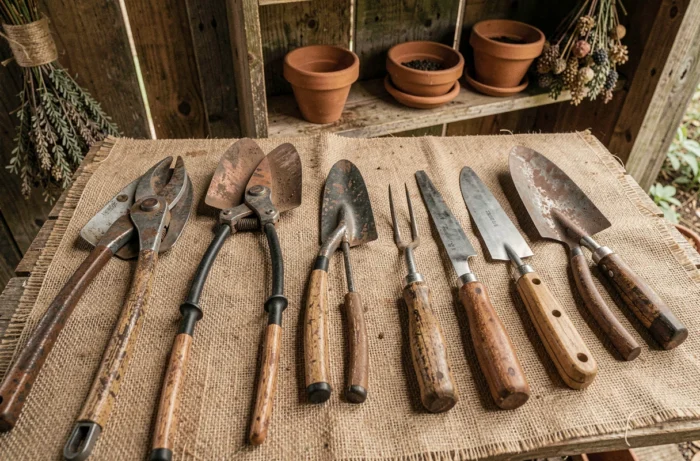
Anvil pruner or bypass pruner: choose according to the diameter and condition of the wood
This technical distinction affects the cleanliness of the cut and the health of the pruned plants. The bypass pruner cuts green, living wood with a clean cut that heals quickly. The anvil pruner crushes more than it cuts, making it suitable for dead or dry wood.
- Green wood less than one centimeter in diameter: bypass pruner, preferably with a progressive return spring to reduce wrist fatigue during long sessions.
- Dead or lignified wood: anvil pruner, whose flat lower jaw absorbs the effort without deflecting the blade.
- Branches of intermediate diameter (between one and three centimeters): ratchet pruner, which multiplies the applied force without requiring a switch to a powered tool.
Using an anvil pruner on green wood crushes the fibers and promotes fungal diseases. This is the most common mistake we observe among amateur gardeners who invest in expensive equipment without knowing this distinction.
Gas mower or battery: decide based on the area and slope of the terrain
The choice between gas and battery power is not just an ecological preference. The slope of the terrain and the area to be covered dictate the appropriate motorization.
On flat terrain of moderate size, a battery mower with a brushless motor offers almost no maintenance and a noise level compatible with use in dense residential areas. In contrast, on slopes greater than fifteen degrees or on large areas, the gas engine retains an advantage in continuous torque and autonomy without recharge time.
Cutting height and deck width
The adjustable cutting height with at least five positions allows for mowing to be adapted to the season. In dry periods, we recommend raising the height to preserve soil moisture. The deck width determines the number of passes required: a wide deck reduces working time but loses maneuverability around flower beds and borders.
- Terrain less than a few hundred square meters with flower beds: compact deck, battery or corded.
- Open terrain of large size without obstacles: wide deck, gas or high-voltage battery motorization.
- Sloped terrain with narrow access: self-propelled mower with variable speed, preferably gas for torque on inclines.
Tool maintenance: what truly extends lifespan
A well-maintained professional gardening tool retains its performance for years. Regular sharpening of pruner and hedge trimmer blades is the most cost-effective action. A dull blade doubles the mechanical effort and accelerates motor wear.
For battery tools, storing batteries at room temperature and at an intermediate charge level (neither full nor empty) preserves capacity over the long term. Lithium-ion batteries lose capacity faster when kept at full charge for weeks.
Cleaning air filters on gas tools after each intensive session prevents carburetor clogging, the leading cause of difficult starting at the beginning of the season. A clogged filter alters the air/fuel ratio and makes the engine run too rich, which clogs the spark plug and reduces available power.