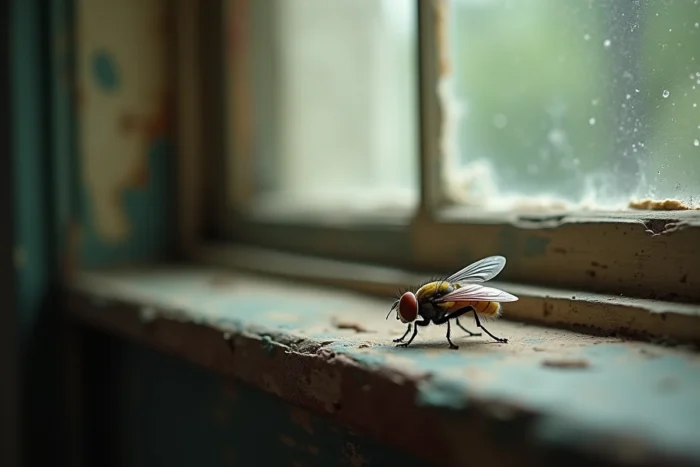
A fly lands on your arm, returns to the table, circles around your head. You swat it away, but it insists. This annoying little dance has nonetheless nourished centuries of beliefs, myths, and symbolic interpretations across very different cultures. Before dismissing the idea with a wave of the hand, let’s explore what the presence of a fly can truly reveal, between ancient symbolism and contemporary interpretation.
The fly as a mirror of the cycle of life and transformation
Have you ever closely observed the life cycle of a fly? The insect goes through four distinct stages: egg, larva (maggot), pupa, and then winged adult. This complete metamorphosis, occurring in just a few days, makes the fly a powerful symbol of rapid transformation.
In several spiritual traditions, this ability to change form relates to the necessity of accepting transitions in one’s own life. A loss, a move, a breakup: the fly reminds us that each stage, even unpleasant, leads to a new state.
This parallel between the biological cycle of the insect and the passages of human life can be found in cultures as distant as Native American shamanic traditions and certain medieval European beliefs. To delve deeper into the spiritual meaning of the fly, one must indeed go beyond the simple reaction of disgust and observe what the animal embodies in its environment.

Solidarity and collective strength: the overlooked African interpretation
The majority of articles on the subject emphasize the negative or individual aspect of fly symbolism. The Bamiléké and Bamoun traditions in Cameroon offer a radically different reading.
In these cultures, the fly symbolizes solidarity and unity. The idea is simple: a single fly remains vulnerable, but a swarm becomes a force. In the realm of small winged insects, it is the collective that ensures survival.
This interpretation contrasts with the Western view, often focused on nuisance or filth. It invites us to consider the fly not as a harbinger of misfortune, but as a reminder of the power of the group and mutual aid.
What this reading changes in the overall symbolism
When we overlay these two frameworks, African and European, we obtain a much richer portrait of the insect. The fly cannot be reduced to a single symbolic register. Depending on the cultural context, it can represent:
- Personal transformation, linked to its cycle of rapid metamorphosis between larvae, pupa, and adult
- Cooperation and the strength of numbers, as in Cameroonian traditions
- The announcement of a visit or the thought of a loved one, according to certain European folk beliefs
- A signal of stagnant energy in a living space, in contemporary esoteric readings
Folklore or fact: what the fly does not reveal
In recent years, fact-checking content has reframed the most widespread beliefs about flies. One point deserves to be made clear: no documented tradition links the area of the body where a fly lands to a specific omen.
The idea that a fly on the left hand heralds money, or that a fly on the right shoulder signals danger, belongs to popular folklore. These interpretations are not based on entomology or coherent historical texts.
This does not detract from the symbolic richness of the insect. The distinction lies elsewhere: the symbol functions as a tool for reflection, not as an oracle. A persistent fly in your home may prompt you to examine what is stagnating around you, without predicting a specific event.
The concrete causes to check first
Before any symbolic interpretation, the presence of flies in a house has material causes that are better to rule out:
- A humidity problem, which encourages laying eggs and the development of maggots
- A poorly closed trash can or forgotten food scraps
- A cleaning deficiency in a hard-to-reach area (under furniture, behind an appliance)
- A drain or siphon where water stagnates
Resolving these practical causes does not contradict the symbolic reading. The two approaches coexist without negating each other.
Fly and introspection: a symbol of personal persistence
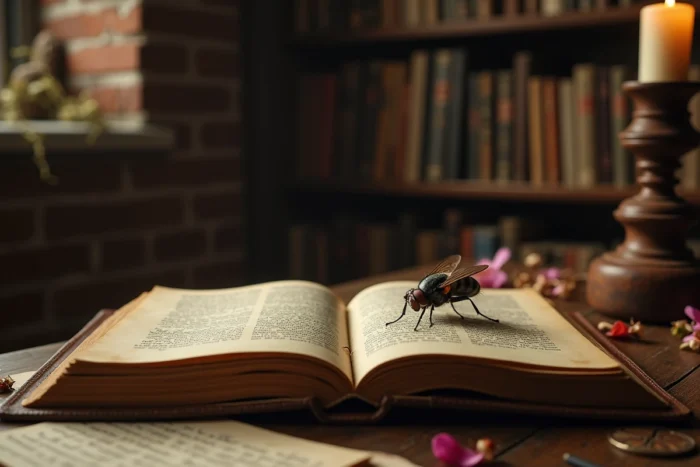
What strikes about the fly is its tenacity. You chase it away, it returns. You close a door, it finds a way in. This stubbornness has inspired metaphors in many languages and traditions.
In the reading of the totem animal, the fly represents the ability to pursue one’s goals despite obstacles. The insect does not give up in the face of a hostile environment. It adapts, navigates around, persists.
This quality, transposed to daily life, refers to resilience. The next time a fly insists on being in your space, consider it an invitation to examine what you may have abandoned too quickly: a project, a conversation, a postponed decision.
The fly does not need to be loved to carry meaning. Its symbolism transcends the centuries precisely because it disturbs: it forces attention where one would prefer to avoid it. Between transformation, collective solidarity, and persistence, this everyday insect condenses much deeper readings than its size might suggest.