
Birkenstock has held a special place in the footwear landscape for over two centuries. Founded in 1774, the German brand built its reputation on a cork and latex sole designed to conform to the shape of the foot. Their presence has extended far beyond summer sandals, with professional ranges aimed at caregivers, cooks, and salespeople.
Professional Birkenstock and consumer models: soles that serve different purposes
The majority of articles about Birkenstock treat the brand as a homogeneous block. The reality is more segmented. The consumer models (Arizona, Boston, Gizeh) share an anatomical cork-latex sole with pronounced arch support. Their purpose remains moderate daily walking.
The professional versions, such as the Arizona Pro, meet a different set of specifications. They incorporate enhanced shock absorption and a slip-resistant outsole, designed for hard floors (hospital tiles, collective kitchen concrete). Hygiene is also a criterion: the materials are easier to clean, and the sole better withstands intensive use for several hours of standing.
An article detailing the benefits of walking well with Birkenstock helps to better understand what each range offers depending on the context of use. Confusing a beach sandal with a model designed for the medical field is akin to comparing a city sneaker with a safety shoe.
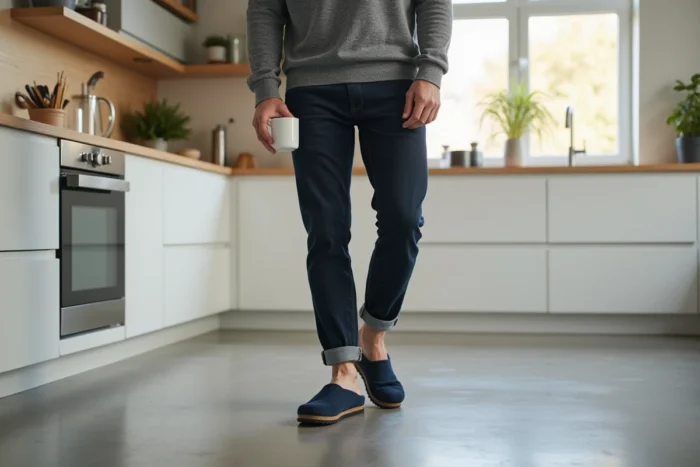
Birkenstock cork sole vs. soft soles: what field feedback shows
Rigid cork is Birkenstock’s technical signature. It stands out from EVA foam or gel soles used by competitors like Scholl or Billowy. The rigidity of cork keeps the arch in a stable position, limiting lateral micro-movements of the foot with each step.
Feedback and comparative tests indicate that Birkenstock is perceived as more favorable for sensitive feet over long durations, particularly in cases of plantar fasciitis or a collapsing arch. In contrast, some competitors with soft soles offer more pronounced immediate cushioning, which can be appealing during a quick fitting in-store.
The difference is especially felt over time. Birkenstock cork requires a breaking-in period, which can be uncomfortable in the first few days. The material gradually molds to the footprint of the foot. This adaptation process is absent in foam soles, which offer instant comfort but lose their structure more quickly.
Plantar fasciitis and arch support: the limits to know
The arch support integrated into Birkenstock alleviates some of the pain associated with plantar fasciitis. Field feedback varies on this point: some people report significant improvement, while others find the arch too high and experience tension in the Achilles tendon.
A podiatrist can determine if the profile of the Birkenstock sole matches the foot’s morphology. A custom orthotic sole remains the gold standard for diagnosed pathologies. Birkenstock positions itself more as a preventive complement than as a medical device.
Thermal comfort and summer walking: an underestimated parameter
Open-toe Birkenstock (Arizona, Gizeh) allow the foot to breathe, making them a logical choice in high heat. Podiatrists recommend this type of open sandal when temperatures exceed heatwave thresholds, provided that foot support remains adequate.
- Cork and leather absorb moisture better than synthetic materials, reducing the risk of irritation between the toes.
- Soft-soled models in EVA (Birkenstock EVA range) are lighter and washable, suitable for the beach or pool, but offer less structural support.
- Birko-Flor versions (synthetic material) dry faster than natural leather, an advantage in humid environments.
Thermal comfort is rarely mentioned in comparisons, yet it directly influences the duration for which one can tolerate their shoes in summer. A foot sweating in a closed sneaker tires faster than a foot ventilated in an open sandal.
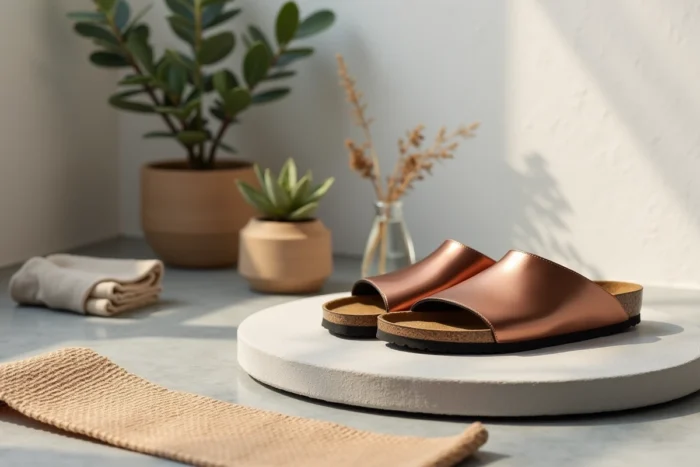
Cork durability and the real cost of a Birkenstock over several years
The purchase price of a pair of Birkenstock exceeds that of most consumer sandals. This initial extra cost is put into perspective when considering the product’s lifespan. Cork can be resoled, allowing the same pair to be kept for several years by only replacing the worn outsole.
This resoling service, offered by Birkenstock or independent cobblers, significantly extends the product’s usage duration. In contrast, a foam-soled sandal whose structure collapses after a season ends up in the trash. The cost per year of use of a well-maintained Birkenstock can turn out to be lower than that of cheaper pairs replaced every summer.
A point of caution regarding counterfeits
The brand’s popularity has led to a proliferation of copies. Counterfeits replicate the appearance of the cork sole but use compressed materials that do not deform in the same way. Arch support is often absent or poorly positioned, negating the benefits for the foot.
- Check the origin: authentic Birkenstock are made in Germany.
- Examine the insole: the logo should be printed, not glued.
- Beware of abnormally low prices on unofficial marketplaces.
The choice between Birkenstock and another brand depends on foot profile, usage context, and long-term budget. For prolonged daily use, whether standing or urban walking, the rigidity of cork and structural support provide a measurable advantage.
For occasional or beach use, softer and less expensive alternatives may suffice. The most relevant choice remains one that takes into account the individual morphology of the foot.