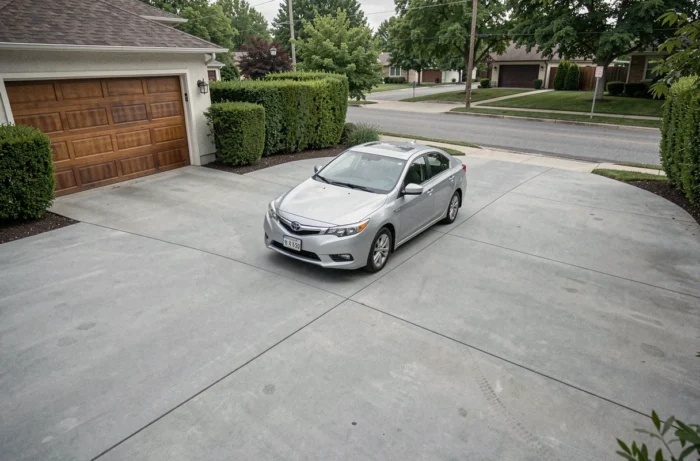
Making a U-turn on a narrow road or in a private driveway requires knowing two pieces of information that are rarely included on the registration document: the vehicle’s turning diameter and the actual width of the available space. Without these references, the driver alternates between forward and reverse, multiplies maneuvers, and increases the risk of hitting an obstacle or encroaching on a sidewalk.
Turning Diameter: The Technical Data That Determines Everything Else
The turning diameter refers to the complete circle described by the outer front wheel when the steering wheel is turned to the maximum. This value, expressed in meters, is found in the vehicle’s technical sheet, usually in two forms: “between curbs” (the most useful in real use) and “between walls” (which includes the body overhang).
Recent city cars have a turning diameter of around 10.3 to 10.5 m. The new Citroën C3, for example, is reported to be about 10.3-10.5 m, placing it in the average for its category for urban use. A compact SUV like the Peugeot 3008 II has a turning diameter of 10.7 m between curbs, which already requires a two-step U-turn on a roadway six meters wide.
The gap widens with hybrid and electric SUVs. The Volkswagen T-Roc hybrid has a turning diameter of 11.1 m, considered difficult to maneuver in the city for this size. Urban electric SUVs (Fiat 600e, Jeep Avenger, Kia EV3, Hyundai Kona Electric, Peugeot e-2008) range between 10.5 and 10.9 m between curbs. Therefore, choosing the right dimension for making a U-turn in a car starts with consulting this technical data specific to each model.
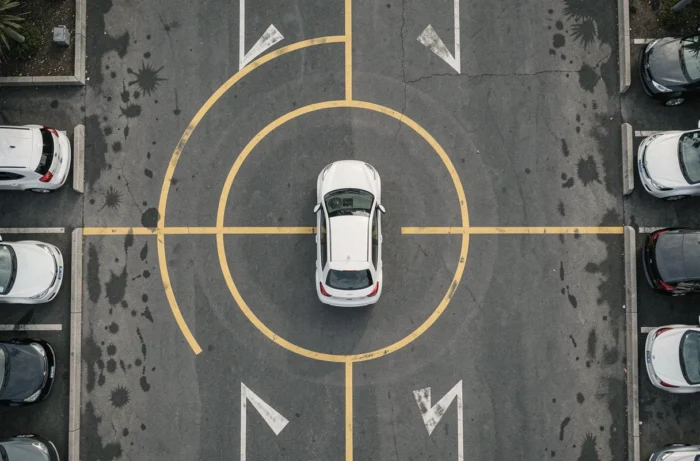
Driveway Width and Turning Area: The Concrete Thresholds
On construction forums, the question keeps coming up: what width should be planned for a driveway where one wants to make a U-turn without going onto public roads? Field feedback converges towards a simple benchmark.
Straight Driveway and U-Turn in One Movement
To turn a vehicle in a single steering motion, a width at least equal to the turning diameter is required. With a city car (about 10.5 m), a 7 m wide driveway is not sufficient for a one-step U-turn. However, a square area of 10.5 m on each side allows for a smooth U-turn without reversing for most sedans and compacts.
If space is constrained, a three-step U-turn (steering, reversing, resuming) remains the standard maneuver. It requires a roadway width of about 6 to 7 m for a standard vehicle, provided that no obstacle (low wall, hedge, post) reduces the usable area.
T or Y Turning Area
When the driveway is too narrow for a direct U-turn, a T or Y area allows for maneuvering in a more compact space. The principle relies on a perpendicular branch where the vehicle reverses before heading back in the opposite direction. Common dimensions for this type of layout:
- Main branch at least 3 m wide (passage of a standard vehicle without folded mirrors)
- Turning branch about 5 to 6 m deep, to allow the vehicle to engage sufficiently before turning
- Total clearance of about 10 to 11 m between the end of the branch and the opposite edge of the main driveway
These values apply to private vehicles. For a utility vehicle or motorhome, the depth of the branch must be increased in proportion to the rear overhang and the turning diameter, often exceeding 12 m.
Fire Access and Urban Planning Standards: Often Ignored Constraints
Fire safety regulations impose minimum dimensions for dead-end roads serving residences. These standards, defined in subdivision regulations and local urban planning plans, aim to ensure the turnaround of emergency vehicles.
A standard fire truck requires a significantly wider turning area than a private vehicle. Wildfire prevention data specify that access must allow for the maneuvering of trucks whose turning diameter can exceed 13 m. Dead-end roads longer than 100 m generally must include a turning device (turnaround, T, Y, or roundabout).
A development permit or building permit at the end of a dead-end can be refused if the turning area does not meet these requirements. Checking the local urban planning document before sizing a driveway prevents the need to redo the grading afterward.
Adapting Sizing to the Actual Vehicle and Daily Use
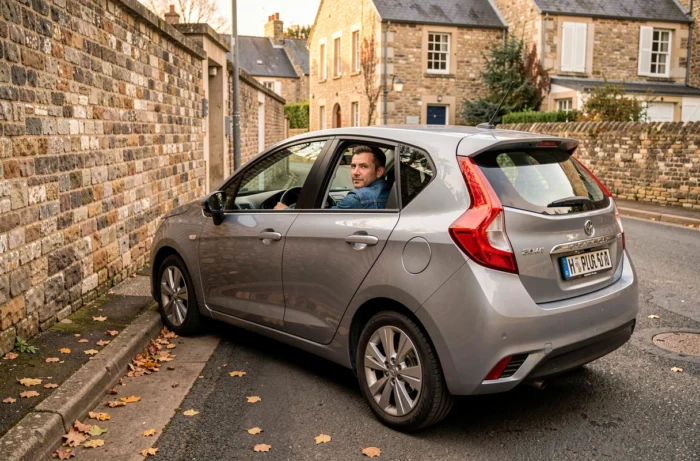
The most common trap is sizing a driveway for the current vehicle without anticipating a change. Switching from a Clio to a family SUV can add a meter to the turning diameter and make a previously comfortable turning area insufficient.
Some parameters rarely taken into account during grading:
- The overhang of the mirrors adds 15 to 20 cm on each side, which reduces the usable width of the driveway
- A gravel or wet surface increases the maneuvering distance compared to a dry pavement
- The presence of high curbs prevents encroaching on the sides and reduces the available margin, unlike simple ground markings
- Rear visibility (rear camera, sensors) influences the maneuvering speed but not the physical space needed
Planning for 10 to 15% more than the turning diameter of the largest vehicle likely to use the driveway is the most pragmatic recommendation. For an SUV with a 10.7 m diameter, this means an area of about 12 m of usable width.
The sizing of a turning area is not governed by a single standard applicable everywhere. It depends on the type of vehicle, the configuration of the driveway, urban planning constraints, and the desired comfort margin. Consulting the vehicle’s technical sheet and the local urban planning document remains the most reliable starting point before any grading work.