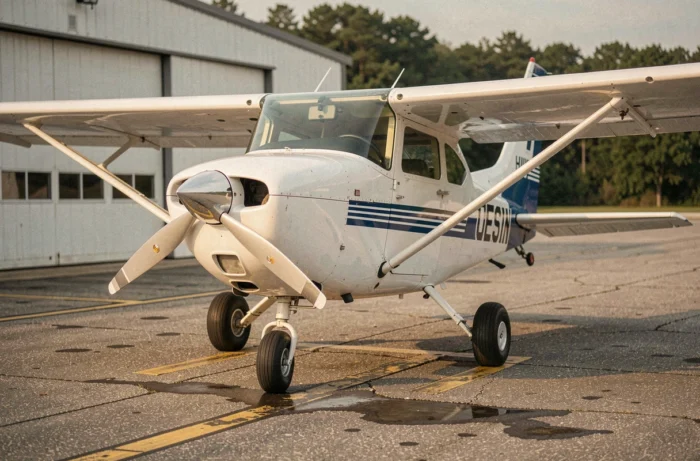
The Cessna 172B is a single-engine piston aircraft produced in the early 1960s. Owning this aircraft involves an annual budget that far exceeds the initial purchase price. Between regulatory obligations, fuel consumption, and unforeseen issues related to the age of the airframe, each expense category deserves a separate analysis to avoid unpleasant surprises.
Specifications of the Cessna 172B and Impact on Operating Budget
The 172B dates back to 1961. This age has a direct consequence on costs: original spare parts are rarer, rubber components (hoses, seals, bushings) need to be replaced more frequently, and corrosion can affect structural areas that are difficult to inspect visually.
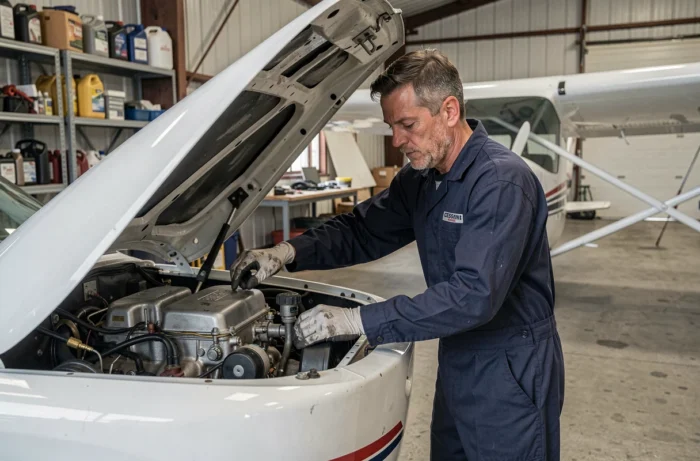
A newer aircraft often benefits from standardized maintenance programs with predictable intervals. On a 172B, the catch-up work on an old airframe is an expense item that budget forecasts often overlook. Control cables, analog instruments, vintage electrical equipment: each aging component can generate an unexpected expense during a routine visit.
To delve into the annual cost of a Cessna 172B, it is essential to clearly distinguish fixed costs from variable costs, then add a realistic provision for unforeseen expenses.
Annual Fixed Costs of the Cessna 172: Hangar, Insurance, and Airworthiness
Fixed costs do not depend on the number of flight hours. They occur every year, whether the aircraft flies or remains on the ground.
Hangaring and Parking
Outdoor parking is cheaper but accelerates the degradation of an aircraft of this age. An individual hangar at a regional French airfield costs several hundred euros per month. Near large urban areas, this rate increases significantly.
A hangar protects the airframe and reduces long-term maintenance costs. On a 172B exposed to the elements, corrosion and aging of seals progress faster, which increases the bill during periodic visits.
Aviation Insurance
Insurance depends on the pilot’s profile (total hours, hours on type), the declared use (leisure, travel, training), and the insured value of the aircraft. For an older single-engine piston aircraft, the annual premium varies according to these criteria but remains a non-negotiable item.
Airworthiness and Regulatory Compliance
The applicable regulatory regime changes depending on the country of registration. In Europe, a Cessna 172B registered under EASA regulations must comply with an approved maintenance program, current airworthiness directives, and engage a Part-145 approved organization or a qualified mechanic for return to service.
In the United States, an aircraft used for private purposes is subject to a mandatory annual inspection. If the aircraft is used for training or rental, an additional inspection every 100 hours is added to the schedule, which practically doubles the cost of scheduled maintenance.
Variable Costs Related to Flight Hours on Cessna 172B
These expenses increase proportionally with flight activity.
Avgas Fuel
The Cessna 172B consumes avgas 100LL. Hourly consumption depends on engine speed and altitude, but this item remains the most visible in the variable budget. The price of avgas fluctuates according to airfields and countries, with notable differences between metropolitan France and other markets.
Engine Maintenance and Potential
The Lycoming O-300 engine equipping the 172B has a manufacturer-specified potential expressed in operating hours. As this limit approaches, a major overhaul becomes necessary. The cost of the engine overhaul often represents the heaviest item over the ownership period. Setting aside an amount per flight hour helps to smooth out this expense.
- Engine oil and filters: regular replacement according to manufacturer recommendations, at each oil change or periodic visit.
- Spark plugs and magnetos: checking and replacement at defined intervals, with a moderate but recurring unit cost.
- Propeller: inspection and possibly overhaul based on the number of hours, taking into account shocks or erosion.
Provisions for Unforeseen Expenses and Airworthiness Directives on Old Airframes
This is the most challenging item to anticipate, and it distinguishes a realistic budget from an optimistic one.

Airworthiness directives (ADs) can impose modifications or additional inspections at any time. On an aircraft over sixty years old, these directives accumulate. Some concern structural elements, while others pertain to model-specific components. Ignoring ongoing ADs exposes one to a loss of airworthiness and the legal inability to fly.
Typical unforeseen expenses on a 172B include:
- Corrosion discovered during an annual visit, requiring the replacement of sheets or partial longerons.
- Replacement of electrical harnesses whose insulation has degraded over time.
- Avionics compliance if the airspace frequented requires recent equipment (Mode S transponder, ADS-B).
Planning an annual financial reserve dedicated to unforeseen expenses allows for absorbing these costs without compromising safety or the operation of the aircraft.
Reducing the Cost of Owning a Cessna 172B: Co-ownership and Flying Clubs
Co-ownership remains the most effective lever to divide fixed costs. Sharing a 172B among two or three pilots reduces the burden of hangaring, insurance, and administrative fees per owner. The legal framework (joint ownership or SCI) deserves special attention to avoid conflicts in case of resale or major breakdown.
The alternative is to fly in a flying club, where the hourly cost already includes maintenance, insurance, and depreciation. Individual ownership is only justified if the availability of the aircraft takes precedence over the hourly cost.
The annual budget of a Cessna 172B primarily depends on the number of flight hours, the parking location, and the actual condition of the airframe. On an aircraft of this age, the most unpredictable variable remains corrective maintenance, the kind discovered when opening the access panels.