
Lemuria refers to a hypothetical continent whose existence was proposed in the 19th century to explain the geographical distribution of lemurs between Madagascar and India. Modern biogeography has since abandoned this hypothesis in favor of plate tectonics. However, the concept has survived, migrating from scientific publications to theosophical circles and then to contemporary spiritual movements, where it occupies a unique place.
Mauritia and the Esoteric Recovery of Geological Discoveries
Since the early 2010s, geology has identified fragments of continental crust submerged under the Indian Ocean. The microcontinent named Mauritia, detected off the coast of Madagascar, is part of these structures buried under layers of volcanic lava. The scientific community sees it as a remnant of the disintegration of the supercontinent Gondwana, with no relation to a lost civilization.
However, French-speaking spiritual pages have relayed these discoveries, presenting them as validation of the Lemurian narrative. This shift is documented: geological data is reinterpreted as evidence of a mythical continent, while the researchers involved have never made such a connection. The gap between scientific publication and its reception in esoteric circles illustrates a recurring mechanism in the history of Lemuria.
Those interested in Lemuria in spirituality often encounter this type of confusion between geological fact and mythical narrative, making the interpretative framework all the more difficult to untangle.
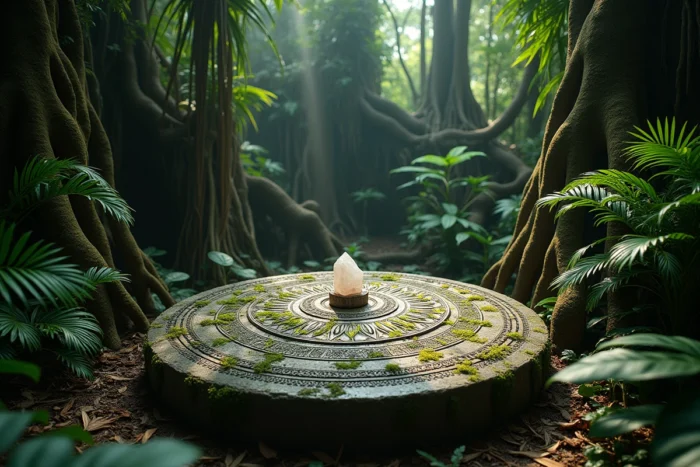
Scientific Origin of the Term Lemuria and Migration to Theosophy
Zoologist Philip Sclater proposed the term “Lemuria” in 1864 to designate a hypothetical land bridge connecting Madagascar to India. The idea aimed to solve a biogeographical puzzle: why did fossil lemurs appear on lands separated by thousands of kilometers of ocean.
A few decades later, Helena Blavatsky integrated this concept into the theosophical cosmogony, making Lemuria the cradle of a “third root race.” The scientific continent became a spiritual founding myth in less than a generation. Blavatsky’s writings, particularly in “The Secret Doctrine,” established a narrative framework that New Age movements later amplified.
This trajectory, from zoological laboratory to esoteric text, distinguishes Lemuria from other myths of lost continents. Atlantis, for example, originates from a philosophical dialogue by Plato. Lemuria, on the other hand, was born from a refuted zoological hypothesis, which gives it an aura of pseudo-scientific legitimacy that some authors still exploit.
Lemurian Crystals and Current Energy Practices
In contemporary practices, “Lemurian seed crystals” hold a special place. These quartz crystals, recognizable by their natural horizontal striations, are presented by some practitioners as memory holders of an ancient civilization. They are used in energy healing and meditation workshops.
No geological study validates the hypothesis of a memory encoded in these quartz. The striations result from well-documented crystallization conditions in mineralogy. The commercial name “Lemurian” is part of a spiritual marketing strategy that emerged in the 1990s-2000s, which helped increase the market value of these stones.
The use of these crystals in therapeutic contexts raises practical questions:
- The provenance of the crystals is rarely traceable, and the term “Lemurian” is not governed by any official mineralogical standard
- The attributed properties (emotional healing, connection to past lives) are based on individual testimonies, not on reproducible protocols
- The price of these quartz far exceeds that of similar unlabeled quartz, raising questions about the role of narrative in perceived value
Workshops and Courses: An Expanding Market
Workshops dedicated to “Lemurian memories” are multiplying in the Francophone space. They offer guided meditations, rituals with crystals, and regression sessions intended to reconnect participants to past lives on the lost continent. Field feedback varies on the effects felt, and the available data does not allow for conclusions about the effectiveness of these practices beyond the subjective framework.
Lemurian Symbols: What the Source Texts Really Say
The symbols associated with Lemuria vary according to authors and eras. In Blavatsky’s work, the symbolism is linked to cycles of races and the spiritual evolution of humanity. In Malcolm de Chazal’s writings, a Mauritian author, Lemuria is closely associated with the symbolism of stone, with explicit borrowings from biblical tradition. Chazal saw in the mountains of Mauritius sacred remnants of a Lemurian past.
These two readings have almost nothing in common except for the name. The theosophical Lemuria speaks of cosmic races and planes of consciousness. The Chazalian Lemuria is rooted in the geological landscape of a real island. Contemporary New Age movements draw from both registers without always distinguishing their sources.
- The theosophical symbolism emphasizes cycles of incarnation and collective spiritual progression
- The Chazalian symbolism connects the sacred to the mineral and the physical landscape of the Indian Ocean
- Current interpretations add elements (akashic records, Christ consciousness) absent from the foundational texts
This layering of interpretative layers makes any assertion about “the” Lemurian symbolism suspect of simplification. There is no unified corpus of Lemurian symbols, but rather parallel traditions that have sometimes intersected, sometimes ignored each other.
Lemuria remains a hybrid object, at the crossroads of an abandoned scientific hypothesis, a 19th-century theosophical construction, and a growing contemporary spiritual market. Each layer adds its own narratives and interests. For anyone interested, distinguishing geological fact from esoteric narrative remains the first useful step.