
On e campus police, each officer has a training space related to their rank, function, and career goals. The problem is that most users simply follow the assigned modules without utilizing the features that document their progress. This documentation plays a direct role in building a promotion file or preparing for a job interview.
Progress tracking on e campus police: actionable data for a promotion file
Have you ever checked your dashboard on the platform after completing a module? Most officers validate their training without paying attention to the indicators that accumulate in the background.
E campus police records several types of data: connection time, validated modules, downloadable certificates. These elements are not only used to prove that a course has been completed. They constitute an actionable record during a job interview or in a file presented to the promotion committee.
Specifically, an officer preparing for a rank advancement should group their modules by competency rather than by date. The platform allows this classification by “pathway” or by “competency,” making the file more readable for an evaluator. A coherent pathway over several months, focused on management skills for example, carries more weight than a list of scattered modules validated at the last minute.
To optimize your training on e campus police, you should treat the platform as a proof tool, not just as a course catalog.

Hybrid training and management modules: what the recent reform changes
A recent regulatory change has broadened the definition of the “training phase for management functions.” Previously, this phase required an in-person format. The new wording removes the mandatory mention of in-person training, paving the way for hybrid or fully online pathways.
For an officer aiming for a management rank, this evolution has a direct consequence: the e-learning management modules completed on e campus police can now count towards the required training phase. Before this change, only internships in schools or training centers were taken into account.
This does not mean that in-person training is disappearing. Practical internships, simulations, and evaluations in real conditions remain on the agenda. However, the theoretical part (team management, legal framework for intervention, ethics) can be covered online, freeing up operational time.
Which modules to prioritize
Not all modules available on the platform carry the same weight in a career progression pathway. Here are the categories to prioritize if you are aiming for a higher rank:
- Modules related to management and supervisory functions, which directly correspond to the skills evaluated during promotion committees
- Training related to the specialties sought in your department (cybersecurity, specialized investigations, mediation), which demonstrate targeted skill development
- Modules for regulatory and ethical updates, often mandatory but also valued as proof of ongoing commitment
CALYPSSO portal and centralized access: organizing your training sessions
E campus police is integrated into a larger ecosystem. Access is through the CALYPSSO portal, which brings together several digital services from the Ministry of the Interior. This centralization has a practical advantage: one single identifier provides access to all tools, avoiding the multiplication of logins and passwords.
The often overlooked point is user profile management. By updating your current rank, assignment, and career goals in your profile, you receive targeted notifications about promotion campaigns and relevant module openings. An outdated profile generates inappropriate suggestions.
Planning your training according to the promotion calendar
Promotion campaigns follow a precise schedule. Validating a management module three weeks before the committee does not have the same impact as having completed it six months earlier, with a documented complete pathway.
The most effective method is to identify the date of the next promotion campaign applicable to your rank, then work backward to plan your sessions. A pathway spread over several months, with regular validations, presents an image of constant progress rather than rushed preparation.
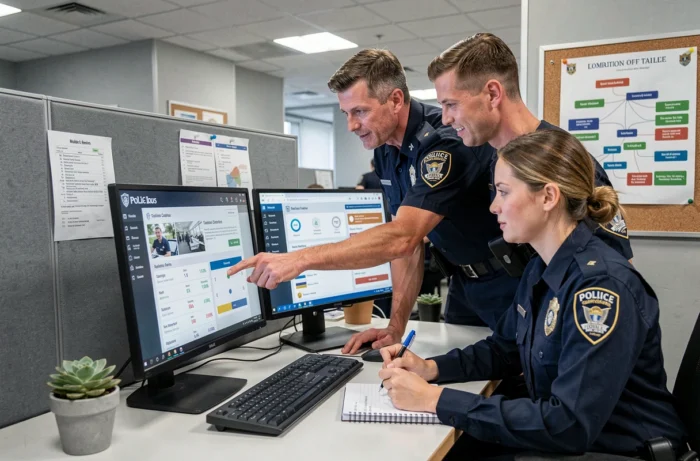
Common mistakes that slow down rank advancement on e campus police
Some behaviors frequently recur among officers who use the platform without tangible results in their careers.
- Following only the mandatory modules without exploring optional pathways related to management skills
- Never downloading their certificates, complicating the creation of the file when it needs to be presented
- Ignoring updates to the user profile, preventing the platform from suggesting modules suited to the targeted rank
- Concentrating all validations in a short period instead of building a coherent and spread-out pathway
Each of these mistakes can be corrected in a few minutes. The gain is measured at the time of the promotion committee when the file speaks for itself.
The e campus police platform does not mechanically accelerate a promotion. It provides the tools to document skill advancement, provided they are used as such. A well-structured, regularly updated pathway aligned with the promotion calendar remains the most concrete lever to support a candidacy for a higher rank.