
The Swiss used car market relies on a fleet that is reputed to be well-maintained, with maintenance schedules adhered to and regular technical inspections. For a buyer, the choice between a private seller and a professional is not just a matter of price. It involves very different legal mechanisms, levels of verification, and protections depending on the chosen channel.
Legal warranty on a used car purchased from a Swiss garage: what the law provides
In Switzerland, the legal warranty on goods, including cars, is generally two years. When a professional sells a used car to a private individual for private use, this period can be contractually reduced to one year, but not below. This minimum of twelve months is the standard in garages.
Between private individuals, the situation differs significantly. Warranty exclusions are common and often expressed by the phrase “sold as seen.” The buyer who signs such a contract waives any recourse in case of a pre-existing defect, unless they can prove that the seller intentionally concealed a flaw.
With a professional, the warranty covers defects that were already present at the time of delivery. Specifically, if a mechanical or electronic problem arises in the months following the purchase and it existed before the sale, the garage must intervene. This protection changes the game for costly components like the gearbox, turbo, or onboard electronics. A specialized garage like the one accessible at https://autowog.ch/ applies this framework, with documented follow-up for each vehicle offered for sale.
Technical inspection before sale: what a professional checks that a private seller cannot
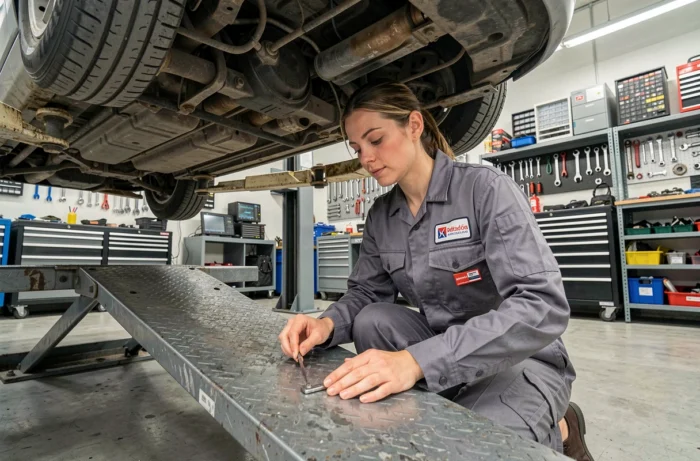
A professional garage has diagnostic tools that a private seller does not possess. Reading error codes via the OBD port, checking paint thickness to detect repaired accidents, inspecting the chassis on a lift: these checks require specific equipment and expertise.
The issue of the odometer illustrates the gap well. Odometer tampering remains a real risk in the used car market, including in Switzerland. A reputable professional cross-references the displayed mileage with maintenance history, service invoices, and data from the cantonal technical inspection. A private individual does not always have access to these cross-checks.
Key inspection points that make a difference
- Complete electronic diagnostics (engine, transmission, airbags, ABS) with archiving of results for the buyer
- Verification of consistency between mileage, wear parts (brake pads, tires, clutch), and documented history
- Inspection of the bodywork and chassis to identify unreported structural repairs
- Examination of registration documents and the circulation permit to confirm the absence of liens or ongoing disputes
These steps do not guarantee the total absence of future problems. However, they significantly reduce the risk of acquiring a vehicle whose actual condition does not match what is advertised.
No right of withdrawal in Switzerland: why the professional contract offers better protection
Unlike what exists in the European Union for online purchases, Switzerland does not provide any legal right of withdrawal after purchasing a vehicle, whether from a private individual or a professional. Once the contract is signed, the buyer is committed.
This absence makes the content of the sales contract all the more crucial. A professional drafts a detailed document that mentions the condition of the vehicle, the mileage, any known defects, warranty conditions, and respective obligations. This formality is not just a commercial advantage: it constitutes the legal basis on which the buyer can rely in case of a dispute.
A contract between private individuals, often drafted from a generic template found online, regularly omits clauses regarding liability for hidden defects. The professional contract holds the seller accountable for verifiable points, which changes the balance of power in case of disagreement.
Insurance and registration: the role of the garage in administrative procedures
Buying a used car in Switzerland involves several formalities: transferring registration with the cantonal automobile service, subscribing to or transferring liability insurance, and sometimes undergoing a technical inspection if the vehicle has changed cantons.
A professional assists the buyer with these steps, or even handles them directly. They provide the necessary documents in the correct format, ensure that the circulation permit is up to date, and can coordinate the inspection appointment if required by the canton.
What the garage manages on your behalf
- Preparation of the complete file for the change of ownership (cantonal forms, insurance certificate, inspection report)
- Verification that the vehicle complies with the requirements of the destination canton, particularly regarding pollution standards
- Issuance of temporary plates or coordination with the cantonal office for a quick transfer
A purchase between private individuals leaves all of these procedures to the buyer, who must navigate alone through the cantonal administrations. For a buyer unfamiliar with the Swiss system, delays and back-and-forth can accumulate.
Going through a professional does not eliminate all administrative complexity. It reduces the risk of error and the time spent on formalities, two factors that weigh into the actual cost of a car purchase. The security of a purchase from a garage relies as much on the vehicle as on the contractual and administrative framework surrounding it.